
Warehouse facilities are often viewed primarily as funding mechanisms, but their long-term success depends on far more than access to capital. Behind every high-performing facility is a disciplined administration framework that supports transparency, risk management, investor confidence, and scalable growth. Whether supporting student loans, solar loans, home improvement loans, personal loans, elective medical loans, or other specialized asset classes, warehouse financing allows organizations to scale efficiently without immediately relying on securitizations or whole-loan sales. As facilities grow, however, administrative complexity grows alongside them. Managing a facility’s borrowing-base calculations, covenant compliance, trigger monitoring, collateral surveillance, lender reporting, and cash reconciliations requires operational precision and specialized expertise.
Warehouse Administration Is More Than Reporting
A common misconception is that warehouse administration simply consists of preparing monthly reports and calculating borrowing bases. In reality, effective administration encompasses a much broader set of responsibilities designed to ensure that financing structures remain compliant, transparent, and scalable.
Warehouse facilities involve multiple moving parts that must remain synchronized. Borrower payments must be accurately tracked and reconciled. Asset performance must be continuously monitored. Financing agreements must be comprehensively reviewed and administered properly. Cash flows must be validated and documented. Reporting obligations must be met on time and in accordance with lender requirements.
As portfolios grow larger and more complex, operational precision becomes increasingly important. Seemingly minor discrepancies can create significant downstream consequences when applied across thousands of loans or multiple financing structures.
A sophisticated administration function operates as an extension of both the lender and the asset owner, providing accountability, oversight, and transparency throughout the facility lifecycle.
Accurate Borrowing Base Calculations Drive Funding Confidence
One of the most critical functions within warehouse administration is the calculation and validation of borrowing bases.
Lenders extend financing based on the characteristics and performance of the underlying collateral. These calculations determine how much funding may be advanced and are often governed by detailed eligibility requirements established within financing agreements.
Calculating borrowing bases accurately requires far more than compiling loan balances. Administrators must evaluate asset performance, apply eligibility criteria, identify ineligible collateral, calculate concentration limits, incorporate advance rate provisions, and validate supporting data before reporting results.
Operational challenges increase as portfolios expand across multiple asset classes, servicing platforms, or financing arrangements. Without disciplined controls, organizations risk overstating collateral values, overstating ineligible loans, misclassifying assets, or introducing reporting inconsistencies that undermine confidence among borrowers and financing providers.
Experienced administration teams implement validation procedures designed to ensure calculations are accurate, repeatable, and fully supported by underlying portfolio data. This level of rigor helps maintain credibility with warehouse lenders while reducing operational risk.
Covenant Monitoring Should Be Proactive, Not Reactive
Many warehouse agreements include financial and operational covenants designed to protect lenders while providing early warning indicators of portfolio deterioration.
Unfortunately, some organizations approach covenant monitoring as a periodic reporting exercise rather than an ongoing risk-management process.
By the time a covenant breach appears in a monthly report, management may have little opportunity to influence the outcome. Effective warehouse administration instead emphasizes continuous monitoring and forward-looking analysis.
This includes providing early warning indicators for concentration limit breaches as well as tracking delinquency migration, charge-off activity, collateral quality indicators, borrowing utilization, and other portfolio performance trends or metrics that may influence covenant compliance.
Organizations that adopt a proactive approach gain valuable time to evaluate emerging risks, communicate with financing partners, and implement corrective actions before issues escalate.
Strong administration partners provide visibility into these trends and help clients understand not only where they stand today, but how portfolios may perform relative to covenant requirements in the future.
Trigger Monitoring Protects Investors and Capital Providers
In many financing structures, operational triggers act as safeguards designed to protect lenders and investors during periods of increased risk. These triggers may be linked to delinquency thresholds, default rates, utilization levels, reserve requirements, or other forms of collateral performance or portfolio characteristics.
When triggers are breached, financing structures often require operational changes ranging from modified funding mechanics to enhanced reporting requirements or shifts in cash flow priorities. Managing these provisions accurately requires detailed knowledge of the transaction documents as well as ongoing visibility into portfolio performance.
The most effective administrators maintain processes that continuously evaluate trigger thresholds and identify emerging risks before they become operational issues. Rather than discovering trigger events that have occurred after reporting periods close, organizations gain the ability to respond quickly, communicate effectively with stakeholders, and manage facilities according to established contractual requirements.
Data Integrity Remains the Foundation
Regardless of facility size or complexity, every warehouse administration function ultimately depends on the quality of underlying data. Borrowing bases, covenant calculations, trigger monitoring, investor reporting, and lender reporting all rely on accurate portfolio information. Unfortunately, many organizations continue to spend considerable time manually collecting, reconciling, and validating data from multiple systems. These processes introduce operational inefficiencies while increasing the likelihood of human error.
Leading administration providers utilize automation, standardized data management practices, and rigorous validation procedures to improve accuracy across the reporting lifecycle. Data is reconciled against source systems, anomalies are investigated, exceptions are documented, and reporting outputs are reviewed before distribution.
This disciplined approach not only improves reporting quality but also strengthens confidence among warehouse borrowers, lenders, investors, auditors, and internal stakeholders.
Transparent Reporting Supports Better Decision-Making
In today’s environment, stakeholders expect more than static monthly reporting packages.
Originators want visibility into portfolio performance. Asset managers seek deeper insights into trends and risks. Financing partners require transparency into collateral and facility activity. Executives need information that supports strategic decision-making.
As a result, warehouse administration has evolved beyond basic report production.
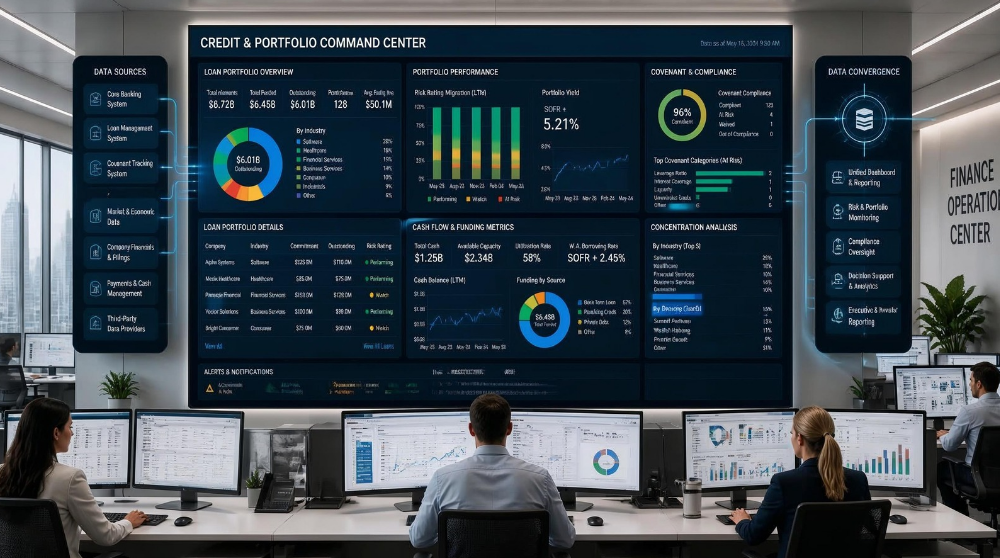
Modern reporting frameworks typically combine detailed operational reporting with portfolio analytics, performance monitoring, risk indicators, cash flow visibility, and customizable dashboard functionality.
The objective is not simply to report what happened. The objective is to help stakeholders understand why performance has changed, identify emerging opportunities, and proactively manage risk over time and across portfolios. Organizations that embrace this level of transparency often make faster and more informed decisions while strengthening relationships with financing providers and investors.
Scalability Matters More Than Ever
Many lending organizations initially build administrative processes internally while portfolios remain relatively small. As assets grow, however, those same processes often become increasingly difficult to maintain.
Manual spreadsheets, fragmented workflows, and limited staffing can create operational bottlenecks that restrict growth.
Scaling a warehouse facility should not require scaling operational complexity at the same rate.
A specialized administration partner provides access to experienced professionals, established controls, reporting infrastructure, and operational processes capable of supporting growth across multiple facilities and asset classes.
Whether managing a single warehouse line or a portfolio of financing arrangements, organizations benefit from having a framework designed to scale alongside future business objectives.
Why the Right Partner Can Create a Competitive Advantage
Warehouse administration is often viewed as an operational necessity. In reality, it has become a strategic component of successful lending and structured finance organizations.
Accurate borrowing-base calculations support funding confidence. Continuous covenant monitoring reduces risk. Trigger management protects stakeholders. Reliable reporting strengthens transparency. Strong operational controls create trust. Collectively, these functions help organizations maintain access to capital, improve operational efficiency, and position themselves for sustainable growth.
For lenders, originators, and asset managers evaluating potential partners, the key question is not simply whether a provider can generate reports. The more important question is whether that provider has the operational expertise, technology, controls, and structured finance experience necessary to support complex financing arrangements at scale.
A trusted partner should bring deep experience across warehouse facility transactions, underlying collateral types, data validation, cash management, compliance oversight, investor reporting, and operational risk management. The ideal provider serves not merely as a reporting vendor, but as a strategic extension of an organization’s finance, operations, and asset management teams.
Organizations should also evaluate whether a potential partner can operate across multiple stages of the asset lifecycle. Warehouse administration does not exist in isolation. It intersects with servicing operations, portfolio analytics, cash management, compliance monitoring, investor reporting, and long-term capital markets strategies. A provider with expertise across these interconnected functions can help clients eliminate operational silos, improve data consistency, and create greater efficiency throughout the organization.
As financing structures continue to evolve and portfolios continue to grow, expectations from warehouse lenders and institutional investors will only increase. Capital providers demand transparency, accuracy, timely reporting, and proactive risk management. Meeting these expectations requires more than capable technology. It requires experienced professionals, disciplined operational controls, and a commitment to precision across every aspect of facility administration.
The organizations best positioned for long-term success will be those that recognize warehouse administration is not simply a reporting requirement. It is a critical foundation supporting liquidity, portfolio performance, investor confidence, and future growth.
When borrowing bases are calculated accurately, covenants are monitored proactively, triggers are managed effectively, and reporting remains transparent, warehouse facilities become powerful engines for growth rather than sources of operational risk. Choosing the right administration partner can make the difference between merely maintaining a facility and fully maximizing its strategic value.
In warehouse administration, operational precision is not just a function of compliance. It is a competitive advantage.

Goal has consistently partnered with clients, offering expertise, guidance, and crucial services that lead to seamless and prosperous transactions. Specializing in ABS investor reports, financial statements, and associated reporting services, we are recognized leaders in the structured finance sector. Our comprehensive suite of solutions goes beyond standard reporting, encompassing vital services such as loan servicing, backup servicing, default prevention, collections, rating agency support, and master servicing. With a steadfast commitment to excellence, we facilitate a wide array of ABS transactions across diverse asset classes, ensuring our clients receive unparalleled support throughout their financial journey. Contact us to discover how we’ve enabled hundreds of clients to successfully tap into the securitization markets; we’ve proudly assisted in four inaugural client securitizations in 2024 alone. We’re eager to discuss your specific questions and objectives, and to tailor a solution that best meets your unique business requirements
To learn more about Goal Solutions and schedule an exploratory call, please visit: https://goalsolutions.com/ or contact:
Brian Cox
Vice President – Business Development
617-680-3515
[email protected]